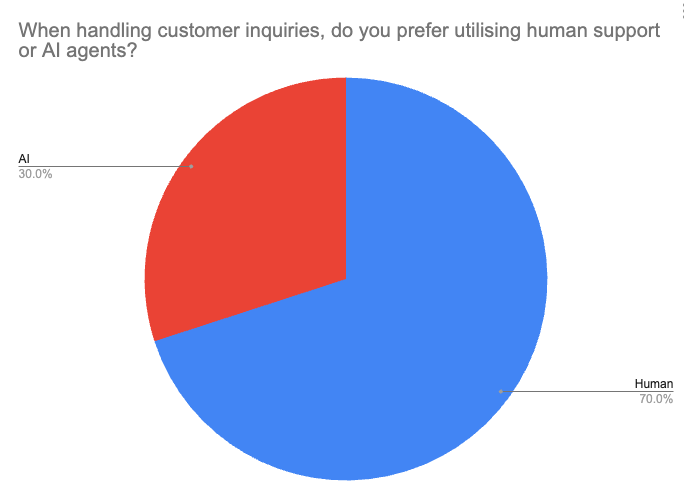
From a business perspective, this is about respect and getting the right answer the first time. Customers feel frustrated when a machine hits a wall, with one respondent noting that “AI can be dumb, especially if the answer is not found in the FAQs section”. Another added that “AI might give a generic solution and not customised to cater for customer requirements”. When a problem gets complicated, your customers want a person who can actually listen.
As the case for AI, there are a group of entrepreneurs who prefer AI as they can scale without fatigue and worry too much about costs. AI agents are preferred simply because they can focus on speed and consistency. AI doesn't get tired, doesn't have or need off days, and stays awake 24/7. For a CEO, this is indeed a productivity win.
One participant highlighted the efficiency, noting that AI offers a faster response, 24x7 availability and a faster learning curve for new policies. Another pointed out, “It’s consistency. AI agents are not influenced by emotion or fatigue”. In this view, AI is the perfect first level of interaction, letting your human team focus on the high-value conversations.
The takeaway is obvious here. Businesses in Malaysia and Singapore don’t intend to pick one or the other. They want to use both. Yes, a hybrid approach is the most practical strategy for them. Let AI handle the generic, fast questions, but make sure a human is ready to step in when a customer needs to be heard. The customers don’t mind AI for the simple stuff, but they still want a human when it matters most. Balancing the two is how you win on both efficiency and experience.